The Longwood Gardens of New England
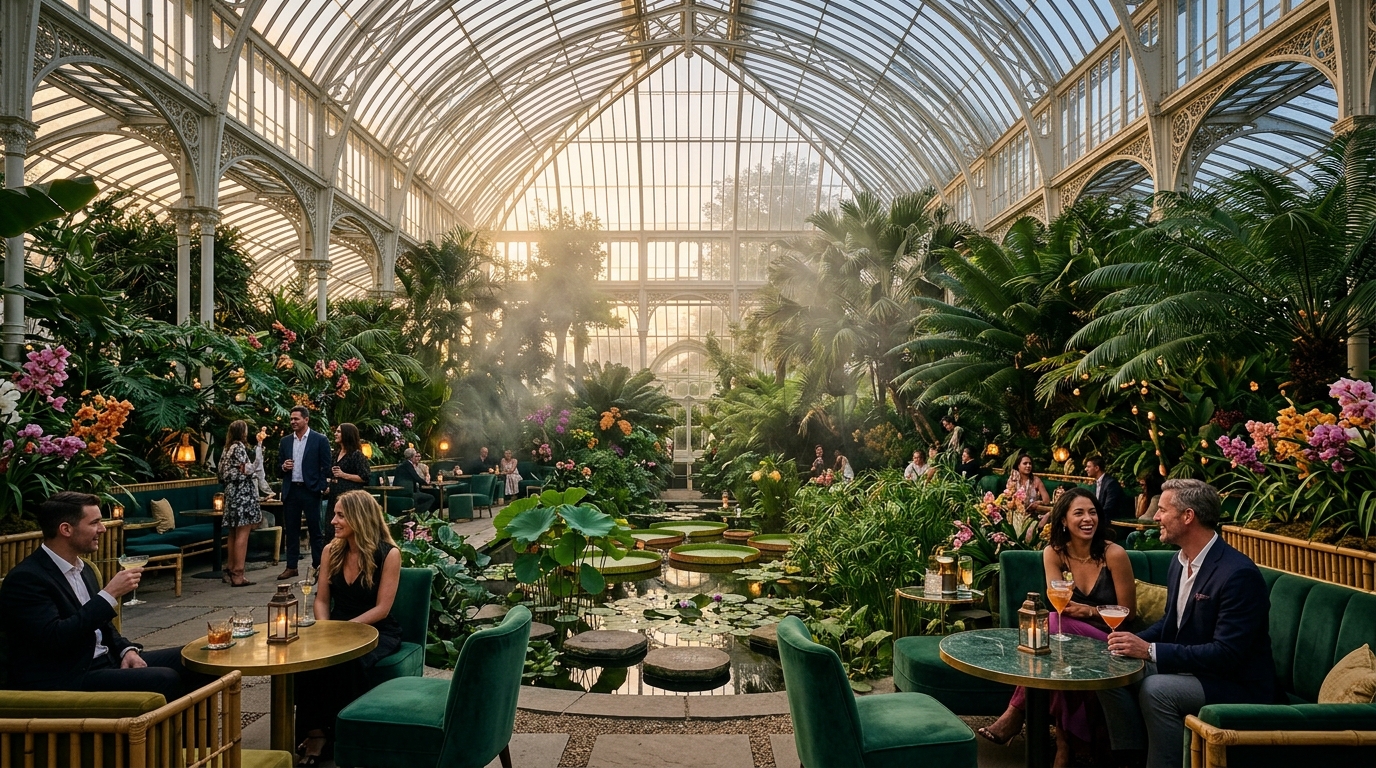
A 55,000 GSF soaring glass biome encompassing tropical rainforests, Mediterranean terraces, orchid gardens, and winter light spectacles. Constructed within the sunken central courtyard, where existing ornamental courtyard trees within the dome footprint are excavated with hydraulic tree spades and transplanted into the arboretum or integrated into living exhibits. Re-utilizing Building 5’s central energy plant, Building 8’s pump station, and 768k SF of parking saves over $38.5M in CapEx vs greenfield construction.
Conceptual Explorations: Illustrating Multiple Viable Opportunities
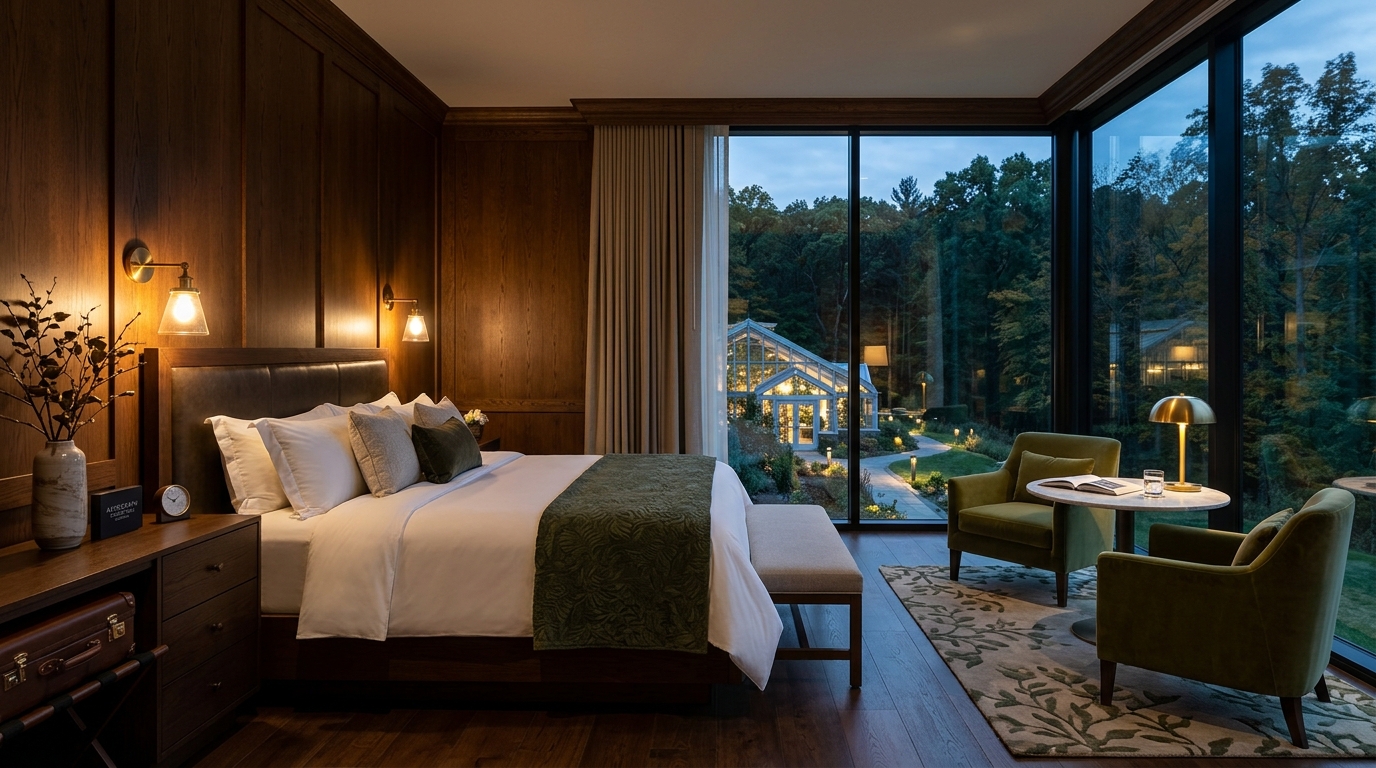
The 228-acre former IBM corporate campus affords extraordinary structural scale, engineering resilience, and landscape versatility. The architectural renderings and visualizations presented across this platform represent conceptual prototypes and visionary goalposts illustrating multiple distinct redevelopment paths. Some concepts explore an ambitious monumental glass conservatory and living biome connector linking the red-brick wings; others illustrate an intact historical preservation of the serene landscaped interior courtyards with stepped private guestroom balconies, sunken gardens, and standalone lakeside glasshouses. Because the campus provides over 1.06 million square feet of built infrastructure, we intentionally present multiple options and variables. Final architectural expressions, structural massing, and interior programming will be refined collaboratively with prospective reuse partners, hospitality operators, and the Town of Southbury.
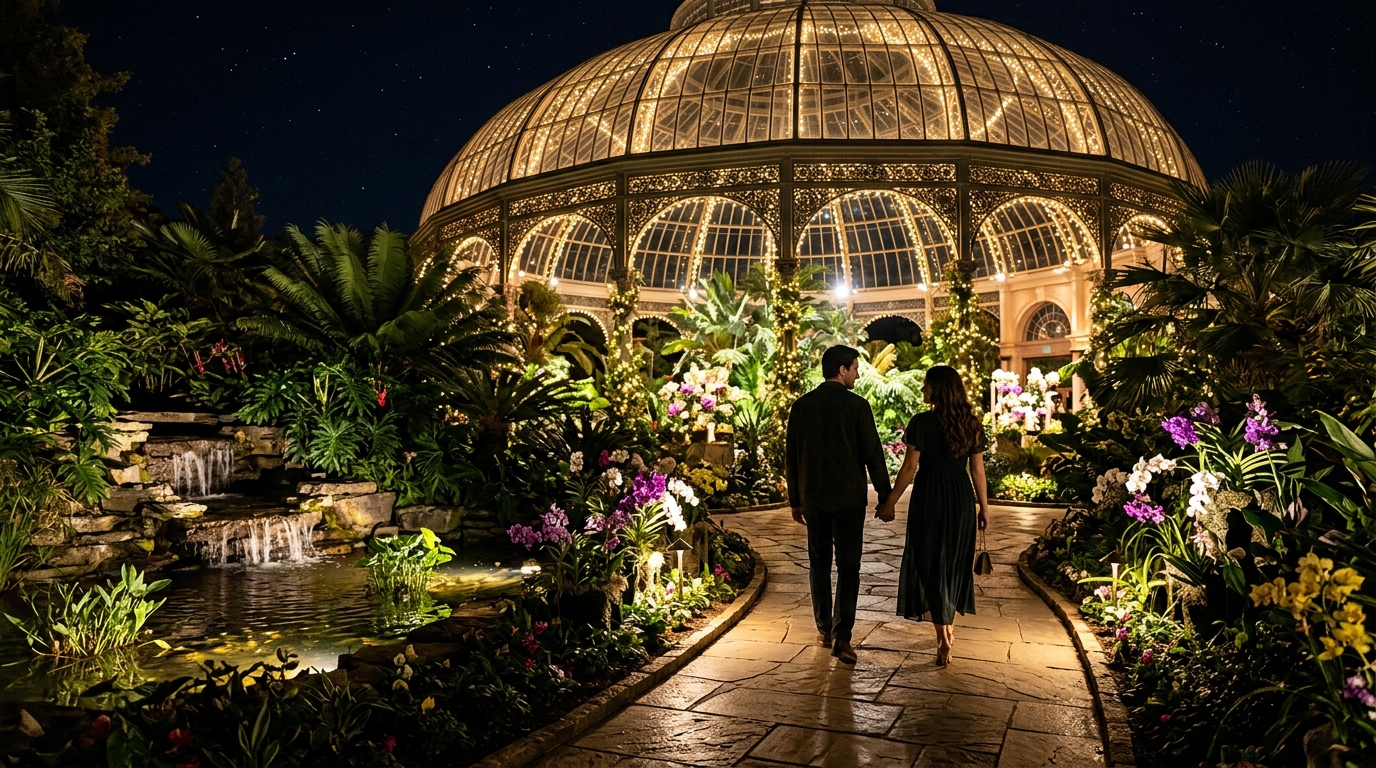
The Illuminated Twilight Walk & Tropical Waterfall
When darkness falls, the soaring glass biomes transform into an enchanting, illuminated night world. Couples, families, and hotel patrons stroll hand-in-hand along stone pathways through tropical palm fronds, rare illuminated orchid collections, and cascading waterfalls under the stars.
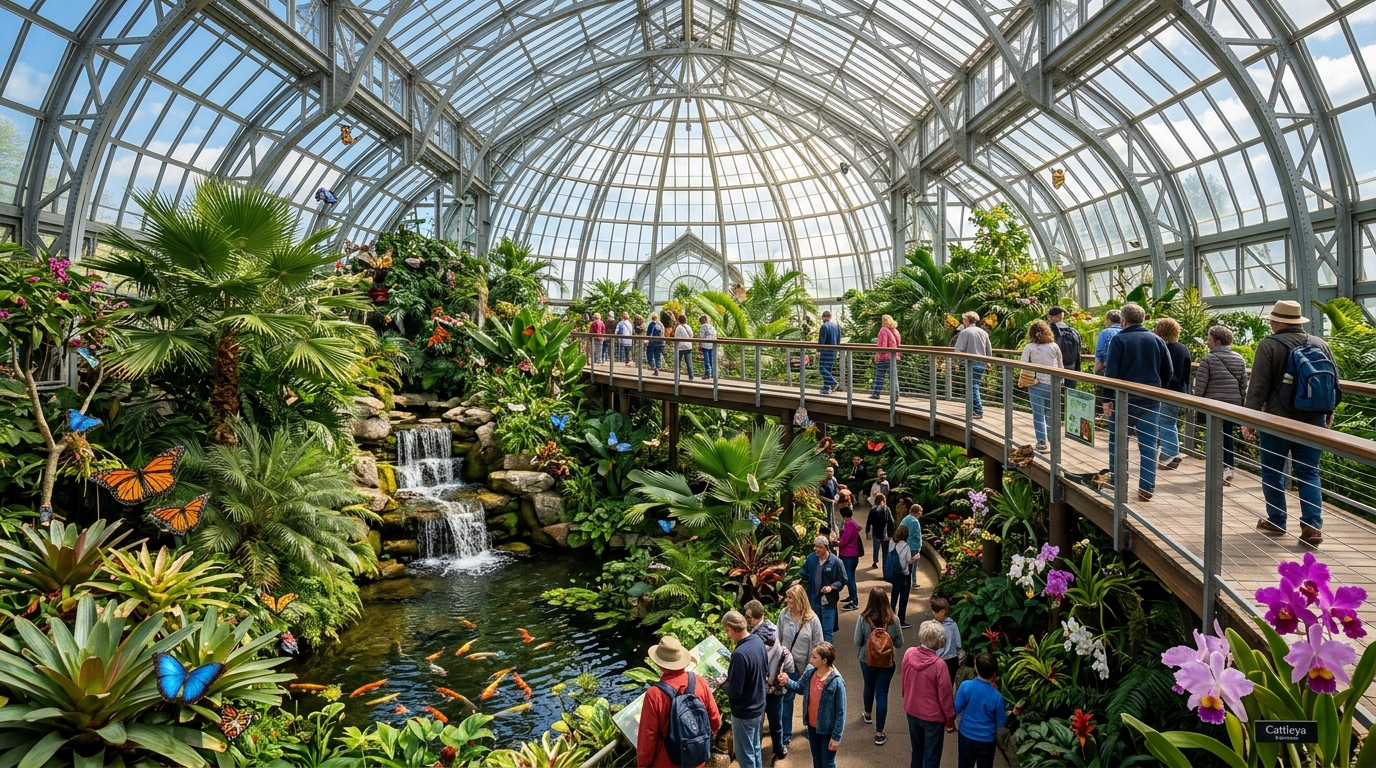
The Tropical Butterfly Sanctuary & Orchid Canopy Walk
Ascend an elevated wooden boardwalk through a soaring glass-domed rainforest teeming with thousands of free-flying tropical butterflies, living koi ponds, cascading waterfalls, and rare tropical and temperate orchid species. Integrated with educational discovery stations curated in partnership with regional universities.
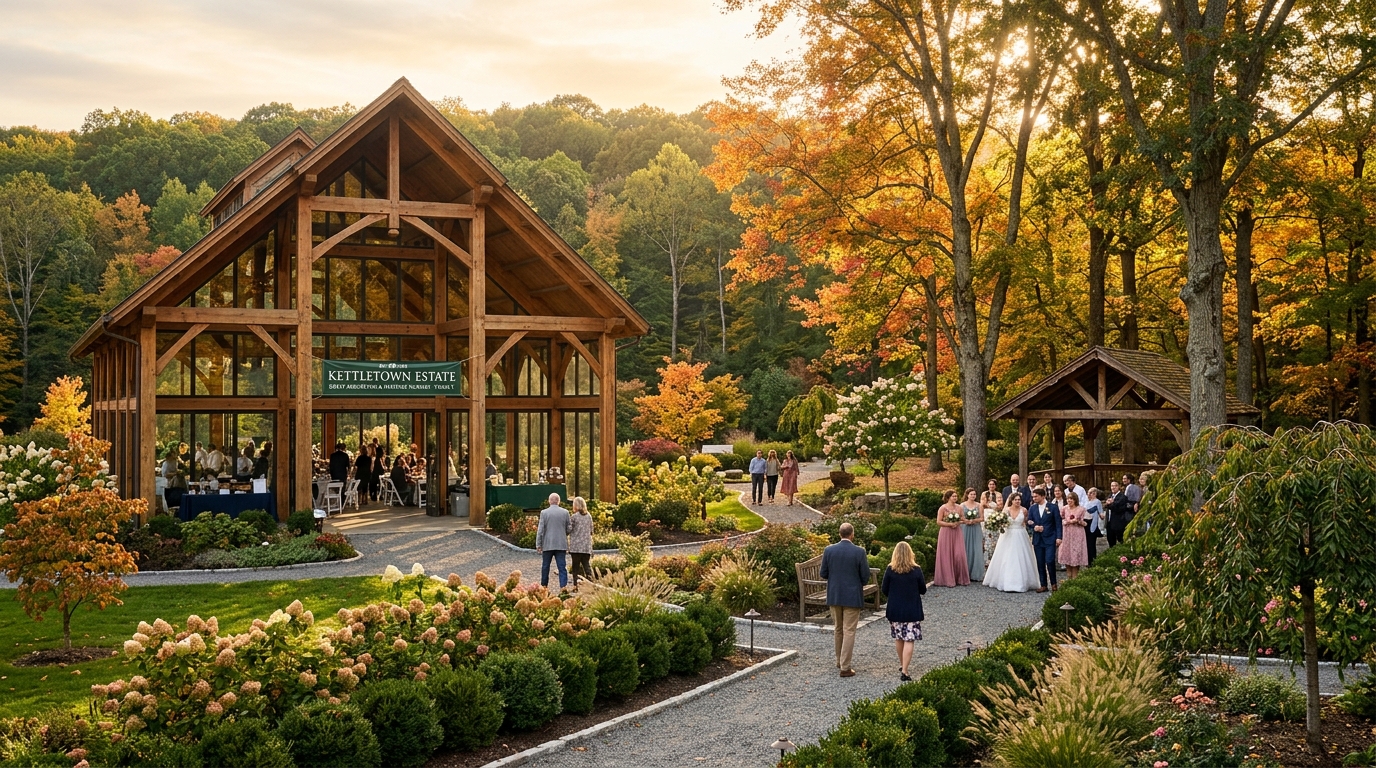
The Great Arboretum & Heritage Glass Pavilion
The botanical estate is NOT a "someday" afterthought—it is physically architected, graded, and planted during initial Phase 1 development. Great gardens and arboretums take years of root development and specimen tree maturation. By planting the master tree collection, opening the heritage nursery, and erecting the timber glass pavilion in Phase 1, the landscape begins growing immediately alongside commercial operations. Weddings and botanical galas launch upon Phase 2 delivery, while living garden infrastructure matures year-over-year into an iconic regional botanical destination.
228-Acre Botanical Gardens, Expansive Walking Paths & Minor Structures
The overarching long-term vision establishes The Kettletown Estate as the premier botanical garden destination in New England. Spanning 228 rolling acres of historic woodland, ponds, and landscaped grounds, the estate integrates miles of curated trails with tasteful architectural follies and greenhouse complexes:
Honest 228-Acre Land Stewardship & Proposed Neighbor Buffer Accord
This concept framework is completely transparent about land use: there are 228 acres to steward appropriately, respectfully, and beautifully. The entire 200-foot perimeter woodland boundary buffer abutting residential neighbors along Kettletown Road, Bullet Hill Road, and Lake George Road is proposed to be protected under non-disturbance conservation covenants as a formal condition of municipal Special Exception and overlay approval—ensuring zero sightline intrusion or buffer reduction.
On the campus interior, the master plan is transparent that selected secondary woodlands and brush are proposed to be thoughtfully converted into active botanical gardens, specimen tree collections, themed plant displays, walking promenades, and low-impact architectural features (the Victorian Glass Orangerie, crystal biomes, traditional working propagation greenhouses, pavilions, and pondside amphitheater). Similarly, erecting the 55,000 SF central courtyard dome over the sunken plaza requires removing existing courtyard trees—all of which will be mechanically dug up using hydraulic tree spades and transplanted into the estate arboretum, nursery, or botanical exhibits rather than destroyed. Even with these additions, total building lot coverage remains at an ultra-low 5.39%, while 380,000 SF of excess asphalt is depaved back into living wildflower meadows.
Authentic Southbury Horticultural Palette vs. Indoor Microclimates
Sugar Maples, Northern Red Oaks, White Pines, Eastern Hemlocks, Mountain Laurel (CT State Flower), Flowering Dogwood, Sweet Pepperbush, Joe-Pye Weed, New England Asters, native hydrangeas, and weeping willows. Formulated to enhance biodiversity and support native pollinator pathways.
Exotic species (tropical rainforest palms, orchids, bromeliads, Mediterranean citrus, and butterfly flora) are strictly housed inside sealed, climate-controlled 74°F glass biomes with hydronic floor heating and automated humidity controls—ensuring zero risk of invasive species transfer.
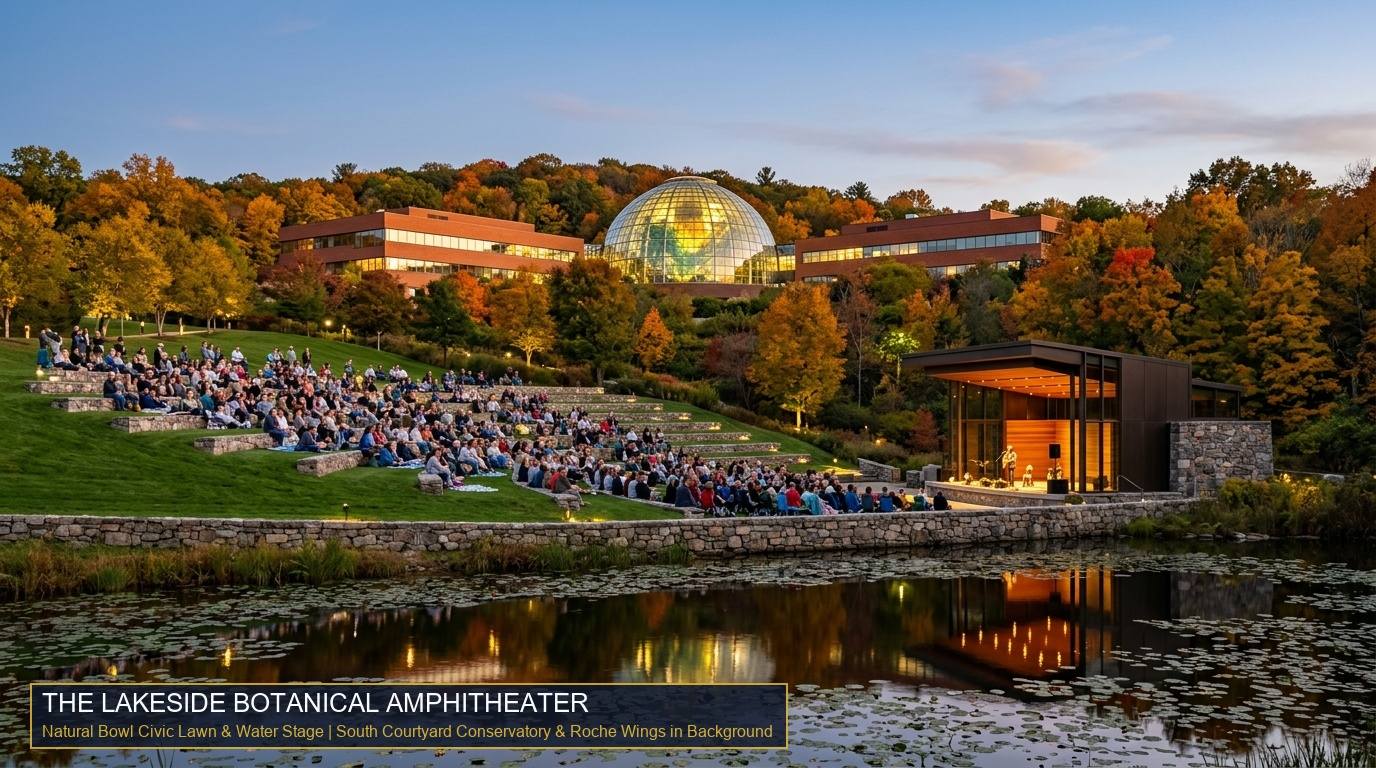
Outdoor Event Spaces: The Garden Amphitheater & Great Lawn
Designed as a natural gathering sanctuary, the estate's outdoor event venues harmonize with the contours of the New England topography to host acoustic outdoor symphonies, theater, community cultural events, and premier galas:
Next Chapter: The Regional Economic Powerhouse
Explore the institutional benchmarks proving how premier living glasshouses generate massive year-round ticket, membership, and event revenue with a 24.5M tri-state catchment.
The Botanical Garden as an Unstoppable Regional Economic Powerhouse
Botanical institutions are not passive flowerbeds—across the Northeast and Mid-Atlantic, institutional-caliber living conservatories function as massive regional economic engines. Institutions like Longwood Gardens (PA), the New York Botanical Garden (Bronx), Phipps Conservatory (Pittsburgh), and Buffalo Botanical Gardens draw hundreds of thousands to millions of visitors annually, command $30M–$75M+ budgets, sustain dozens of boutique hotels and dining rooms, and generate tens of millions in municipal tax revenues. Yet Southern New England has never possessed a monumental glass conservatory biome and botanical estate of this scale—until now.
How Premier Living Glasshouses Transform Regional Economies
Longwood Gardens
1,077 acres and 4.5 acres of historic heated conservatories. Draws 1.6 million annual visitors and generates over $120M in regional economic activity. Turned rural Kennett Square into a renowned culinary and horticultural capital, sustaining dozens of inns, boutique wineries, and farm-to-table dining establishments.
NY Botanical Garden & Haupt Glasshouse
250 acres featuring the Enid A. Haupt Conservatory (one of the nation's premier Victorian glasshouses). Draws 1.2 million annual visitors. The Orchid Show and Holiday Train Show command lines around the block at $35/ticket, injecting millions into nearby Arthur Avenue restaurants, hotels, and mass transit.
Phipps Conservatory & Botanical Gardens
15 acres with a historic 1893 glasshouse and modern living net-zero expansion. Draws 500,000+ visitors annually, generating $16M+ gross revenue. Serves as Pittsburgh’s premier wedding and gala venue (hosting 100+ galas/yr) and anchors surrounding university and neighborhood retail foot traffic.
Buffalo Botanical Gardens (Lord & Burnham)
11.4-acre historic tri-dome conservatory in South Park, Buffalo. Drives 150,000+ visitors in a mid-sized post-industrial market, serving as an irreplaceable cultural anchor that spurred $25M in nearby neighborhood parkland reinvestment, youth botany programs, and tourism spending across South Buffalo.
Regional Botanical Benchmark: Scale, Hotel & Parking Comparison
Evaluating physical constraints, luxury lodging integration, and parking capacity across leading Northeast & Mid-Atlantic institutions
The Kettletown Botanical Estate
Longwood Gardens
Kennett Square, PA
All visitor lodging spills over to outside Brandywine Valley inns and highway chains.
Lots fill rapidly to 100% capacity during peak holiday shows; requires extensive traffic marshaling & queue management.
New York Botanical Garden (NYBG)
Bronx, New York City
Strictly subway/train and day-trip transit visitors. Zero overnight leisure retreat capture.
Severe traffic gridlock on Fordham Road & Bronx River Pkwy; expensive off-site parking.
Coastal Maine Botanical Gardens
Boothbay, Maine
Dependent on coastal B&Bs and motels with limited winter operations.
Unpaved seasonal gravel parking subject to weather and mud constraints.
Phipps Conservatory & Botanical Gardens
Pittsburgh, PA (Schenley Park)
Surrounding urban hotels located miles away in Downtown or Oakland districts.
Relies on municipal park street meters; severe shortage during peak flower shows and evening galas.
Buffalo Botanical Gardens
Buffalo, NY (South Park)
No conference or retreat hospitality lodging on campus.
Shared with Olmsted South Park municipal visitors.
New England Botanic Garden at Tower Hill
Boylston, MA (Worcester)
Day-trip visitors only; no overnight conference or leisure hospitality.
Limited surface parking footprint in rural location.
| Botanical Facility | Location | Grounds Scale | Glass Biome / SF | On-Site Hotel? | Dedicated Parking | Primary Missing Constraint |
|---|---|---|---|---|---|---|
|
The Kettletown Botanical Estate
Benchmark Master Plan
|
Southbury, CT (I-84 Exits 14/15) | 228 Contiguous Acres | 55,000 GSF Living Dome | YES • 160 Luxury Keys Marriott Autograph | 1,150 Active (2.4k Built) 380k SF Repurposed to Solar | None — Fully Integrated Eco-System (Lodging + Biome + Parking + IT) |
| Longwood Gardens | Kennett Square, PA | 1,077 Acres | 196,000 GSF | No lodging Area hotel spillover | Surface & overflow lots (fills quickly to capacity) | Requires outside hotels; winter visitation drops midweek without captive lodging |
| New York Botanical Garden (NYBG) | Bronx, New York City | 250 Acres | 44,000 GSF Haupt Glasshouse | No lodging Urban transit day-trip | Extremely constrained / paid garage & street congestion | Severe traffic/parking congestion on Fordham Road; no overnight retreat capture |
| Coastal Maine Botanical Gardens | Boothbay, Maine | 300 Acres | Minimal glass (outdoor focused) | No lodging | Gravel seasonal lots | Heavily seasonal summer dip; non-operational in deep winter; seasonal gravel parking |
| Phipps Conservatory | Pittsburgh, PA | 15 Acres | 43,500 GSF | No lodging | Limited metered street parking | Tight urban footprint; zero room for expansive trail network; severe street parking limits |
| Buffalo & Erie County Botanical | Buffalo, NY | 11.4 Acres | 22,000 GSF | No lodging | Shared park surface parking | Limited auxiliary commercial revenue; high municipal tax subsidy need |
| Tower Hill Botanic Garden (New England) | Boylston, MA (Worcester) | 171 Acres | 12,000 GSF Orangerie | No lodging | Modest surface lots | Limited indoor biome capacity; modest winter attraction draw; lacks lodging infrastructure |
22,000 Recurring Members
Botanical gardens command one of the highest sustaining membership loyalty rates in culture. At an average $140 annual membership fee, 22,000 member households generate $3.08M in predictable recurring annual cash flow prior to a single general admission ticket sold.
Four-Season Monetization
By pairing 228 outdoor landscaped acres with 55,000 SF of heated crystal biomes, winter yields peak rather than slump. The Winter Holiday Light Exhibition and Orchid Canopy Walk attract 140,000+ visitors between November and February when outdoor attractions are shuttered.
The Resort Lodging Moat
Every other garden comp suffers from "day-tripper syndrome"—visitors leave at 4:30 PM and spend their hotel and dinner dollars elsewhere. The Kettletown Estate captures the full hospitality stack: overnight resort stays ($345 ADR), spa treatments, and hearth dining.
Next Chapter: The Unfair Logistical Advantage
Greenfield attractions struggle with years of parking and traffic entitlements. Review the campus's turn-key 2,400-car civil infrastructure and parking repurposing strategy.
The Unfair Logistical Advantage: Turn-Key Infrastructure vs. Greenfield Nightmares
Constructing a large-scale public attraction from scratch today is an insurmountable civil and political challenge in New England. Blasting rocky ledge, acquiring 200+ acres, paving massive lots, and handling traffic spillover routinely derails projects. The IBM Southbury campus solved this entire equation 35 years ago: engineered specifically for nearly 2,500 daily corporate employees with dedicated multi-lane highway ramps and 768,500 SF of engineered paved parking. The redevelopment retains 1,150 active stalls to comfortably absorb peak holiday crowds, while repurposing 380,000 SF of excess asphalt into clean agrivoltaic solar and living nurseries.
1. Zero Parking Burden on Southbury
The campus possesses 768,500 SF of built asphalt with 1,150 active parking spaces preserved (out of 2,400 originally striped spaces) and commercial lighting plus subsurface stormwater detention. 380,000 SF is repurposed into clean solar and living nurseries. Even during peak holiday flower festivals (Christmas light shows, tulip festivals, weekend symposiums), every vehicle parks comfortably on-site. Zero cars parked along Southbury roads or neighborhood lawns.
2. Dedicated Highway Ingress / Egress
Engineered specifically by the State of Connecticut and IBM in 1987 to handle nearly 2,500 commuters arriving simultaneously. Dedicated multi-lane direct interchange ramps off I-84 Exit 15 and Route 6/67 channel buses, families, and attendees directly onto the wide perimeter ring road. Zero traffic passes through Southbury Historic Center or Main Street.
3. Self-Contained Hospitality Synergy
Traditional botanical gardens lack lodging and lose money on weekdays. By uniting the gardens with a 160-key luxury resort hotel, three destination dining rooms, and an Orangerie gala venue, visitors convert into high-spending multi-day resort guests who dine on-site, frequent Southbury shops, and generate recurring local lodging and meal taxes.
Terraced Parking Master Plan: Active Stalls vs. Strategic Repurposing
IBM originally developed tiered paved parking fields across 768,500 SF of paved area to accommodate nearly 2,500 daily corporate employees arriving simultaneously. Our adaptive reuse generates a peak demand of only 1,150 staggered spaces across restored lots and solar canopies. Rather than maintaining hundreds of thousands of square feet of empty asphalt, 380,000 SF is permanently depaved and repurposed into productive clean energy, botanical production, living meadows, and EV charging infrastructure.
Active Visitor & Hotel Parking
Preserved across the middle tier and foreground arrival court. Provides seamless valet drop-off at the grand porte-cochère, dedicated ADA accessible spaces, and self-parking for hotel, conference, dining, and conservatory guests.
Agrivoltaic Solar Canopies
Architectural solar canopies erected over the upper crescent tier. Generates clean power directly offsetting conservatory climate control loads while offering shaded covered parking and qualifying for CT C-PACE financing.
Living Nursery & Cold Frames
Repurposed into on-site horticultural production yards, specimen tree acclimatization, and seasonal floral cold frames. Saves millions in third-party planting contracts while supporting student vocational apprenticeships.
EV Supercharging & Depaving
40-stall DC fast-charging plaza powered by on-site substation and solar. Outlying steep asphalt fingers are depaved and returned to native Connecticut pollinator wildflower meadows and stormwater bioswales.
Every major objection a municipality traditionally has to a regional tourist draw—traffic jams, lack of parking, noise, school crowding, and fiscal drag—is neutralized by the campus's unique physical anatomy. It is a self-contained 228-acre island of infrastructure: it has its own power generation, its own pump stations, its own internal electric micro-transit shuttles, its own hotel beds, its own wood-fired hearth restaurants, and its own 1,150 active parking spaces backed by 2,400 built civil capacity. Yet the economic fruits—$1.8M in annual town revenue, 320 direct FTE jobs, student vocational apprenticeship opportunities for regional technical students, and tens of thousands of visitors frequenting Southbury boutiques, golf courses, and antique shops—flow freely into the local community.